
INTRODUCTION
The intrauterine contraceptive device (IUCD) is a preferred method of contraception by many women and couples because it acts locally within the uterine cavity without systemic effects. It is a reliable, cost-effective, and long-acting contraceptive that provides a rapid return to fertility upon removal and is suitable for use by a wide range of women. The copper T-380A which is the most commonly used in our setting, can be used for a duration of 8 -10 years. IUCD insertion and removal are generally simple and easy gynaecological procedures. For its proper and effective use appropriate pre- and post-insertion counselling is essential. It should be removed at its expiry or when the woman does not need it anymore such as when one desires to conceive or attains menopause (ACOG Practice Bulletin 121, 2011).
Complications related to IUCD use are relatively uncommon but may be serious. Immediate post-insertion complications include pain, uterine perforation, and bleeding. Medium-term complications (within 3–6 months) include expulsion, malposition, abnormal bleeding, and pelvic pain. Long-term complications may include persistent bleeding, embedment into the myometrium, displacement, uterine perforation, or accumulation of pus within the uterine cavity. These long-term complications are more likely when the IUCD is retained beyond its recommended duration, particularly into the postmenopausal period (Bacanakgil & Yıldırım, 2018). One of the complications reported amongst postmenopausal women with retained IUCDs is the collection of purulent material within the uterine cavity, known as pyometra (3.4). The risk increases significantly if the IUCD is retained for >5 years beyond the recommended duration of use (Li & Chang, 2008). Pyometra results from accumulation of endometrial secretions, due to inflammation coupled with blockage or stenosis of the cervix which prevents the natural drainage of the endometrial discharge. It is a rare entity whose incidence ranges from 0.03 to 0.11 %, among all women but increases up to 13.6% in postmenopausal women (Browne, 2022; Chan et al., 2001). Pyometra may develop secondary to various clinical conditions or situations including retained IUCD, which is reported to account for 28.6% of cases (Lien et al., 2010). The proposed mechanism is cervical stenosis or obstruction which blocks drainage of endometrial secretions (Jang et al., 2024; Ohno et al., 2025).
In this paper, we present a 56-year-old postmenopausal woman, with an un-perforated pyometra associated with IUCD retained for 26 years with no co-morbidities or malignancy.
CASE PRESENTATION
AM, 56 year old para 5+0, postmenopausal woman, presented with suprapubic pains, vaginal discharge which was occasionally blood stained, on and off for about 4 years. She had an IUCD inserted at a rural public facility after her last delivery. She had gone back to the same facility on reaching menopause requesting its removal and after “something” was done she was told it had been removed, although it was not shown to her. About five years later she developed a watery non-foul-smelling vaginal discharge. She went to the same facility and was reassured. She later developed suprapubic pains and the discharge became foul-smelling. She went to several facilities seeking help and was only put on antibiotics and analgesics, which would give her very temporary relief. During one of these visits a pelvic ultrasound and some laboratory tests were done, but was not told their findings. She was given the same treatment and sent away. She sought the help of a gynaecologist who after examination told her she had cancer of the uterus for which an urgent hysterectomy was required. The family decided to get a second opinion, hence the visit to my private clinic.
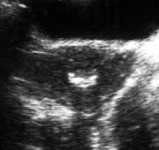
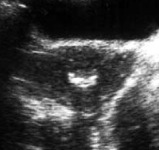
On examination, she was in a fairly good general health, not pale, and afebrile. The abdomen was soft, with mild suprapubic tenderness, no rebound tenderness and no palpable mass. Pelvic examination revealed normal vulva, vagina and cervix, no visible strings or discharge. The uterus was slightly enlarged but mobile, no adnexal mass but generalized pelvic tenderness. A pelvic ultrasound revealed a slightly enlarged uterus, with an intrauterine IUCD surrounded by fluid. The endometrial lining was not discernible. Laboratory work up was unremarkable. The results were discussed with her and the family, and a plan to remove the IUCD in theatre under anaesthesia was made.
Examination under anaesthesia revealed a slightly enlarged but freely mobile uterus, no adnexal masses or visible discharge. Cervical dilation was performed, after which a moderate amount of foul-smelling discharge drained out. The IUCD (CuT380A) was retrieved with ease using long curved artery forceps. It did not have strings. A manual vacuum aspiration (MVA) was performed, and additional purulent material was aspirated. Examination of the aspirated material revealed pus only, with no identifiable tissues.
She continued using antibacterial medications: metronidazole 400 mg eight-hourly and erythromycin 500 mg six-hourly for seven days, and Ibuprofen 400 mg eight-hourly for five days.
She was followed up at two-weekly intervals for two months and subsequently six-monthly for two years, during which she remained asymptomatic. Five year later, she has not had any complaints. An ultrasound examination showed a normal postmenopausal uterus and other pelvic organs. She was discharged from the clinic but advised to return if noticed any problems.
DISCUSSION
An IUCD may be retained in utero beyond its expiry period or when not required anymore either deliberately or forgotten. One of the contributing factors is poor pre and post insertion counselling and follow up. The reported retention duration is quite variable with the longest being 50 years post-insertion (Aniulienė & Aniulis, 2014). The presented patient was 56 years old, six years postmenopausal, who had had the IUCD (CuT380A) for 26 yrs. The IUCD was neither forgotten nor deliberately left in by the patient. She believed that it had been removed by the clinic staff. The clinic nurse lied to her that the IUCD had been removed.
Retention beyond its expiry, as in the presented patient, may be associated with several complications. Among the more serious ones include pyometra (Chuang et al., 2013; Li & Chang, 2008). Reports indicate that about 28.6% of pyometra are associated with retained IUCD (Lien et al., 2010). The risk increases with duration of retention in particular if it is > 5 years (Charonis & Larsson, 2009). It is highest in older postmenopausal women as they’d inevitably have had it for much longer than premenopausal women. This is coupled with the changes in the genitalia following menopause. After menopause the endometrium loses its resistance and is not shed repeatedly. There may be endometrial infection and if the drainage through the cervical canal is blocked the secretions are retained. This may lead to pyometra. The presented case was six years postmenopausal and had had the IUCD for 26 years.
Genital tract malignancy is the primary cause of pyometra, while other contributing factors include retained intrauterine device (IUD) or foreign body, radiation therapy, endometrial lesions, senile cervicitis, puerperal infection, uterine fibroid and congenital cervical anomaly (Jang et al., 2024; Ohno et al., 2025).
Majority of women with pyometra are in their 6th decade of life, majority being approximately 72 years old (Agarwal et al., 2011). This would be about 10 to 20 years after menopause, as in our presented case. The longest reported retention in literature is 50 years (Aniulienė & Aniulis, 2014), and the oldest woman with pyometra associated with an IUCD retention was a 78 year old Taiwanese woman who had a huge pyometra (Chuang et al., 2013). It was not indicated how long she had had the IUCD.
The reported classical symptoms of pyometra are postmenopausal vaginal bleeding, malodorous vaginal discharge and lower abdominal pains (Chan et al., 2001; Chuang et al., 2013; Li & Chang, 2008). However over 50% of cases are asymptomatic, especially if un-ruptured (Ou et al., 2010). The clinical findings are often non-specific and may include an enlarged tender uterus depending on the amount of pus. There may be pus discharge from the uterine cervix and visible IUCD strings, if not broken off or drawn into the cervix or uterus as the latter enlarges. Transvaginal ultrasound and CT scan remain the main diagnostic tools for pyometra during which an enlarged uterus with fluid and intra-cavity IUCD with poorly defined endometrial zone are commonly seen (Bacanakgil & Yıldırım, 2018; Chuang et al., 2013). The presented case had lower abdominal pains, vaginal discharge which was at times blood stained. She did not have history of fever, although that cannot be ruled out. On examination the uterus was slightly enlarged, no visible discharge or IUCD threads from the cervix. An ultrasound showed an IUCD in the uterine cavity surrounded by fluid.
The mainstay management of pyometra with an IUCD is its removal, drainage of the purulent material and endometrial aspiration (Lien et al., 2010). Others have done percutaneous drainage but on an experimental level only (Ohno et al., 2025). In debilitated patients, some recommend antibiotics with other supportive treatments (Sugathan et al., 2026). Use of antibiotics for un-ruptured pyometra remains controversial as some case series showed good recovery without antibiotics (Ou et al., 2010). However, most gynaecologists recommend intravenous administration of wide spectrum antibiotics (Lui et al., 2015; Ouh et al., 2023). Tissue sampling of the aspirated material is necessary to exclude malignancies (Mukai et al., 2022). Some authors recommend ripening of the cervix prior to dilatation and drainage of the purulent material (Jamal et al., 2023), irrigation of the uterine cavity with hydrogen peroxide (3% solution), and provision of uterotonics (Hou et al., 2013). Yet others recommend leaving in a catheter to prevent recurrence reported to be about 33.0% (Álvarez-Sarrado et al., 2020; Chan et al., 2001). The presented case had removal of the IUCD and drainage of the material after cervical dilation as the cervix was tightly closed. The aspirated material and purulent material were sent for laboratory examination, and the results indicated it was sterile, there was no micro-organisms. There was no evidence of malignancy either. She did well on antibacterial treatment.
The most common pathogens associated with pyometra include Escherichia coli, Bacteroides fragilis, Streptococcus species, and Pseudomonas aeuroginosa. In about 5-17% of cultures of the aspirated materials or from the IUCD are sterile (Chan et al., 2001; Vadhadiya et al., 2025). The presented case belonged to this latter category.
In some cases and especially if there is a lot of pus in the cavity, the uterus may rupture. This is one of the most serious complications of pyometra. Fortunately it is an extremely rare complication. Our presented case had moderate amount of pus, which may explain the fact that the uterus had not ruptured. It may also be due to the fact that she was in generally good health and did not have uterine comorbidities.
CONCLUSION
Long retention of an IUCD may be associated with pyometra, which may present with postmenopausal symptoms. Prompt removal at its expiry on when no longer required as on attaining menopause is important to avert this and related complications such as uterine rupture, its migration outside the uterus, with deleterious sequelae. Pre- and post-insertion counselling and follow up are critical in this aspect.
There is also need for continuous medical education for health professionals in the management of family planning programmes and services, in particular with regards to IUCD, as well as proper postmenopausal complaints, to avoid unnecessary hysterectomies with attendant morbidities as well as potential mortality. While pyometra is a rare cause of abdominal pain or abnormal vaginal discharge in postmenopausal women, it should be considered in the differential diagnosis in females of advanced age with such symptoms. Health care providers should always ensure proper documentation of all procedures carried out, as well as provide adequate counseling.