
BACKGROUND
Pregnancy is a natural physiological condition that majority of healthy women experience without complications. However, a small proportion develop severe obstetric complications or exacerbation of pre-existing medical conditions requiring admission to an intensive care unit (ICU) (Tasew et al., 2022). The appropriate utilization of high-quality ICU services improves maternal outcomes and reduces maternal mortality, which remains disproportionately high in low-income countries. Maternal mortality is estimated at 430 per 100,000 live births in low-income countries compared with 13 per 100,000 live births in high-income countries, with sub-Saharan Africa accounting for approximately 70% of maternal deaths worldwide (Koukoubanis et al., 2021; Soares et al., 2020; Tasew et al., 2022).
Management of critically ill obstetric patients presents unique challenges because of the physiological changes of pregnancy and the need to optimize outcomes for both the mother and fetus. The incidence of obstetric ICU admission is higher in developing countries (0.13–4.6%) than in developed countries (0.08–0.76%), while mortality following obstetric ICU admission is substantially higher in low- and middle-income countries than in high-income settings (Priyadarshini & Seema, 2022; Tasew et al., 2022). Management of critically ill obstetric patients presents unique challenges because of the physiological changes of pregnancy and the need to optimize outcomes for both the mother and fetus. The incidence of obstetric ICU admission is higher in developing countries (0.13–4.6%) than in developed countries (0.08–0.76%), while mortality following obstetric ICU admission is substantially higher in low- and middle-income countries than in high-income settings (Anane-Fenin et al., 2021; Ozumba et al., 2018).
Hypertensive disorders of pregnancy, obstetric haemorrhage, and sepsis remain the leading indications for obstetric ICU admission worldwide, although their relative frequencies vary across regions and healthcare settings (Anane-Fenin et al., 2021; Nandini et al., 2023) (Priyadarshini & Seema, 2022). Studies from Europe, Asia, and North America have generally reported favorable outcomes, with relatively low mortality and high discharge rates following ICU admission (Pirzada et al., 2024) (Oliveira et al., 2019) (Sevdi, 2022). In contrast, studies from sub-Saharan Africa have demonstrated considerably higher ICU mortality despite similar admission indications, highlighting persistent inequalities in critical care capacity and maternal healthcare delivery (Anane-Fenin et al., 2021; Felicia et al., 2022; Ozumba et al., 2018). In Kenya, obstetric admissions accounted for 1.25% of ICU admissions, with haemorrhage, sepsis, HELLP syndrome, thromboembolism, cardiomyopathy, and anaemia being the main indications for admission. Despite critical care management, one-third of admitted patients died (Githae et al., 2011). In Ghana and Nigeria, hypertensive disorders of pregnancy accounted for the majority of obstetric ICU admissions, with mortality rates of approximately 26% reported in both settings (Anane-Fenin et al., 2021; Felicia et al., 2022).
Rwanda has made remarkable progress in reducing maternal mortality, achieving one of the highest annual rates of maternal mortality reduction globally. Nevertheless, maternal mortality remains high, with an estimated lifetime risk of maternal death of 1 in 125 and a maternal mortality ratio of 203 per 100,000 live births according to the 2019–2020 Rwanda Demographic and Health Survey. Limited evidence exists regarding the characteristics and outcomes of obstetric patients admitted to ICUs in Rwanda. Previous studies conducted in two teaching hospitals reported that obstetric patients accounted for 12.8% of ICU admissions, with sepsis and peripartum haemorrhage being the leading indications and an ICU mortality of 54.3% (Rudakemwa et al., 2021). Similarly, data from the University Teaching Hospital of Kigali (CHUK) identified peritonitis, hypertensive disorders of pregnancy, and obstetric haemorrhage as the leading causes of severe maternal morbidity (Rulisa et al., 2015).
Despite these findings, there remains a paucity of data describing the indications for ICU admission and outcomes of obstetric patients across tertiary hospitals in Rwanda. This study therefore aimed to assess the indications for ICU admission and the outcomes of obstetric patients admitted to the ICUs of two tertiary teaching hospitals in Rwanda.
MATERIALS AND METHODS
This was a retrospective cross-sectional study conducted in two tertiary and teaching hospitals in Rwanda (Rwanda Military Teaching Hospital (RMTH) and King Faisal Hospital Rwanda (KFHR)) over a five-year period from 1st January 2020 to 31st December 2024. Ethical approval was obtained from the Institutional Review Boards of RMTH and KFHR. Access to medical records was granted by hospital administration.
The study population consisted of all obstetric patients (from the antepartum period up to 42 days postpartum) admitted to the ICUs of RMTH and KFHR between 1 January 2020 and 31 December 2024. A census sampling technique was employed; therefore, all eligible records meeting the criteria during the study period were included. Data were collected using a structured data extraction sheet. The primary outcome was maternal outcome (improved, died, or survived with disability). Secondary outcomes included the ICU admission rate, indications for ICU admission, causes of postpartum haemorrhage (PPH), causes of sepsis, and length of ICU stay.
Data were analyzed using SPSS version 25 and Stata software version 17. Descriptive statistics such as frequencies, percentages, means, and standard deviations were used to summarize the data. Chi-square tests were used to assess associations between categorical variables and maternal outcomes. Statistical significance was considered at p < 0.05. Results were presented using tables, figures, and narrative summaries.
RESULTS
Obstetric ICU Admission Rates
During the study period, a total of 4,763 patients were admitted to the intensive care units of the two hospitals, of whom 403 were obstetric patients. This corresponds to an overall obstetric ICU admission rate of 8.5%. RMTH recorded 349 obstetric ICU admissions among 3,117 total ICU admissions, yielding an admission rate of 11.2%, while KFHR recorded 54 obstetric ICU admissions among 1,646 total ICU admissions, corresponding to an admission rate of 3.3%.
Socio-demographic and Clinical Characteristics of Obstetric Patients Admitted to ICU
A total of 403 obstetric patients were admitted to the ICUs of both hospitals between January 2020 and December 2024. The mean age of the patients was 31.0 ± 7.2 years. The largest proportion of patients was aged 25–34 years (n=173, 43.0%), followed by those aged 35–44 years (n=135, 33.6%) and 15–24 years (n=87, 21.6%). Only 1.7% (n=7) of patients were aged 45 years or older. Regarding parity, more than half of the patients were multiparous (n=189, 52.2%), while 31.5% (n=114) were primiparous and 16.3% (n=59) were grand multiparous. Most ICU admissions were recorded at RMTH (86.6%), whereas KFHR accounted for 13.4% (n=54) of admissions. The mean ICU length of stay was 5.3 ± 10.5 days.
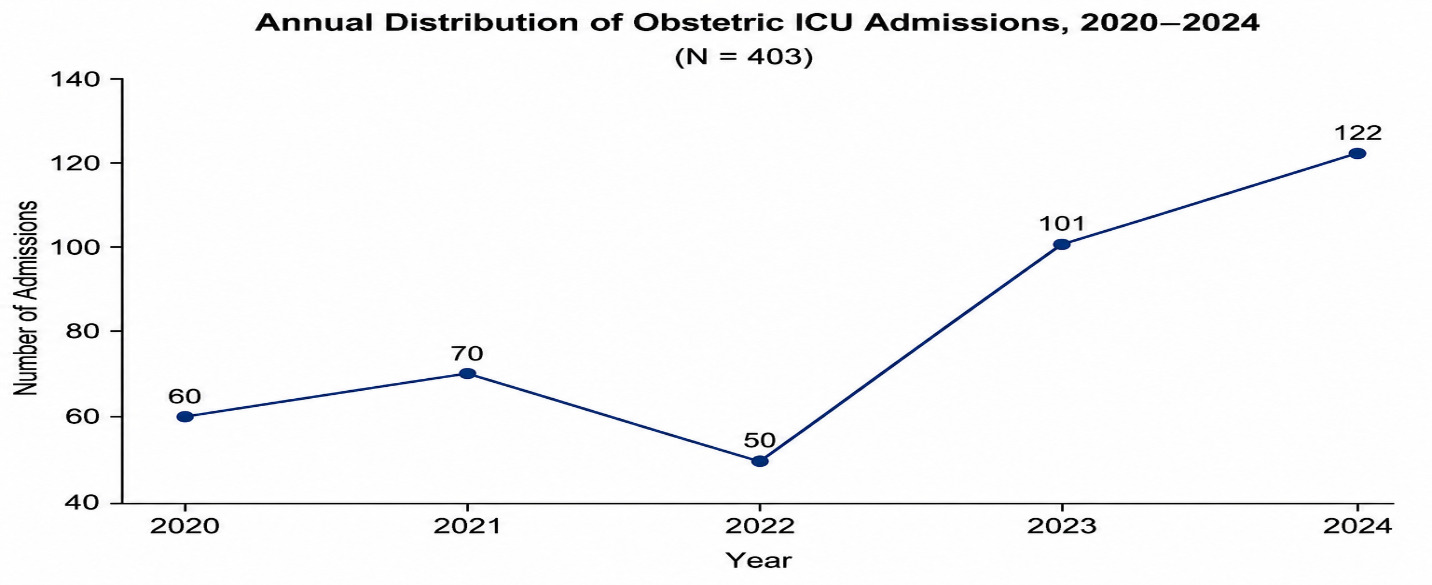
Annual trend of obstetric ICU admissions (2020–2024)
Annual obstetric ICU admissions showed an overall increasing trend during the study period, rising from 60 cases in 2020 to 122 cases in 2024. The lowest number of admissions was recorded in 2022 (50 cases), while the highest occurred in 2024 (122 cases). More than half of all obstetric ICU admissions (55.3%) occurred during 2023 and 2024, indicating increased utilization of ICU services by obstetric patients in the latter years of the study period.
.png)
Admission Indications among Obstetric Patients Admitted to ICU
Obstetric haemorrhage, sepsis, and hypertensive disorders of pregnancy were the predominant indications for ICU admission. Postpartum haemorrhage was the most common indication, accounting for 27.0% (n = 109) of admissions, followed by sepsis (23.8%, n = 96) and eclampsia (16.9%, n = 68). Together, these three conditions accounted for 67.7% of all obstetric ICU admissions. Severe preeclampsia accounted for 6.0% (n = 24) of admissions, while rheumatic heart disease contributed 3.2% (n = 13). Less common indications included diabetic ketoacidosis, meningitis, pulmonary embolism, and severe malaria, accounting for 6.2% (n=25) of admissions. Other indications (16.9%, n = 68) comprised pulmonary oedema, septic shock, anaesthesia-related complications, stroke, asthma, epilepsy, cardiac disorders, malignancies, trauma, and other less frequent conditions.
Outcomes of Obstetric Patients Admitted to ICU
Of the 403 obstetric patients admitted to the ICU, 205 (50.9%) improved and were discharged, 194 (48.1%) died, and 4 (1.0%) survived with residual disability, resulting in an overall ICU mortality rate of 48.1%. The case fatality rates for sepsis, postpartum haemorrhage (PPH), and hypertensive disorders of pregnancy were 32.5%, 28.4%, and 16.5%, respectively.
Factors Associated with Maternal Outcome
There was no significant association between maternal outcome and age group (χ² = 2.691, p = 0.847) or parity (χ² = 7.639, p = 0.106). However, the hospital of admission was significantly associated with outcome (χ² = 12.445, p = 0.002). Patients admitted to KFHR had a higher proportion of improved outcomes (72.2%, n=39) than those admitted to RMTH (47.6%, n=166), whereas mortality was higher at RMTH (51.6%, n=180) than at KFHR (25.9%, n=14).
Causes of Obstetric ICU Admission by Hospital
Postpartum haemorrhage (PPH) and sepsis were the leading causes of obstetric ICU admission. The most common causes of PPH were traumatic obstetric complications (30.9%), uterine atony (27.7%), and placenta accreta spectrum (26.6%), while sepsis was mainly attributed to post-caesarean section peritonitis (46.8%) and infection following unsafe abortion (24.5%). The distribution of PPH causes differed significantly between the two hospitals (χ² = 11.68, p = 0.020), whereas the distribution of sepsis causes was similar (χ² = 5.33, p = 0.149).
DISCUSSION
This study found an overall obstetric ICU admission rate of 8.5% across the two study hospitals. This rate is lower than the 12.8% reported in a previous study conducted at other Rwandan referral and teaching hospitals (CHUK and CHUB) by Rudakemwa et al (2021). It is also lower than the hospital-based obstetric ICU admission rates reported in West African countries such as Nigeria (25.3%) and Ghana (25.7%) (Anane-Fenin et al., 2021; Felicia et al., 2022). However, the admission rate observed in this study is considerably higher than those reported in Kenya at Aga Khan University Hospital (1.25%) (Githae et al., 2011), India (1.84%), South Korea (0.22%) (Panda et al., 2018; Yi et al., 2018), and Portugal (0.8%) (Oliveira et al., 2019). These differences may be explained by variations in referral systems, ICU admission criteria, availability of critical care resources, and the burden of severe obstetric complications across different healthcare settings.
RMTH recorded a significantly higher obstetric ICU admission rate (11.2%) than KFHR (3.3%). This difference is likely attributable to RMTH’s role as a national referral and teaching hospital that receives a larger number of critically ill obstetric patients from a wider catchment area, whereas KFHR primarily serves a more localized population with fewer referrals of complex cases.
The mean ICU length of stay was 5.3 ± 10.5 days. This finding is lower than that reported by Rudakemwa et al., who found a mean ICU stay of 6.06 ± 7.53 days (Rudakemwa et al., 2021), but higher than the median ICU stay of two days reported in a previous study conducted at CHUK (Tuyishime et al., 2019). The mean length of stay observed in this study is comparable to reports from Poland and Portugal, where the median ICU stay was five days (Krawczyk et al., 2021; Oliveira et al., 2019). These comparisons should, however, be interpreted cautiously because some studies reported median rather than mean lengths of stay.
Obstetric ICU Admission Indications
The leading indications for obstetric ICU admission in this study were postpartum haemorrhage (27.0%), sepsis (23.8%), and hypertensive disorders of pregnancy (22.9%, combining eclampsia and severe preeclampsia). Together, these conditions accounted for 67.7% of all obstetric ICU admissions and contributed to the majority of maternal deaths, emphasizing that they remain the principal causes of severe maternal morbidity and mortality in Rwanda.
These findings are consistent with studies conducted both within Rwanda and internationally, which have identified postpartum haemorrhage, sepsis, and hypertensive disorders as the leading indications for obstetric ICU admission (Anane-Fenin et al., 2021; Krawczyk et al., 2021; Oliveira et al., 2019; Panda et al., 2018; Rudakemwa et al., 2021; Yi et al., 2018). However, differences exist between high- and low-income countries. In many high-income settings, hypertensive disorders of pregnancy are the most common indication for ICU admission, whereas haemorrhage and sepsis predominate in low-resource settings because of delays in recognizing obstetric emergencies, delayed referral, limited access to comprehensive emergency obstetric care, and shortages of critical care resources.
A notable variation was observed between the two study hospitals. Sepsis was more frequently encountered at RMTH, whereas postpartum haemorrhage was relatively more common at KFHR. These differences may reflect variations in referral patterns, infection prevention practices, obstetric case mix, and the complexity of patients managed at each hospital.
Causes of Postpartum Haemorrhage and Sepsis
Postpartum haemorrhage was mainly caused by traumatic obstetric complications (30.9%), uterine atony (27.7%), and placenta accreta spectrum (26.6%). The predominance of traumatic causes at RMTH suggests that the hospital receives a larger proportion of referred patients with complicated labour, previous caesarean sections, uterine rupture, and other high-risk obstetric conditions requiring surgical intervention. In contrast, uterine atony was relatively more common at KFHR, which may reflect differences in obstetric case mix and intrapartum management practices.
Sepsis was predominantly caused by post-caesarean section peritonitis (46.8%) and infection following unsafe or septic abortion (24.5%). These findings highlight the continued burden of postoperative infections and abortion-related sepsis as important contributors to maternal critical illness. The high proportion of post-caesarean infections underscores the importance of strengthening surgical safety, perioperative infection prevention, antimicrobial stewardship, and timely recognition of postoperative complications. Although the causes of postpartum haemorrhage differed significantly between the two hospitals, there was no significant difference in the distribution of sepsis causes, suggesting similar infection patterns across both facilities.
Maternal Outcomes
The overall maternal mortality rate among obstetric ICU patients was 48.1%, while 50.9% of patients improved and were discharged and 1.0% survived with residual disability. Mortality was significantly higher at RMTH (51.6%) than at KFHR (25.9%), whereas survival was significantly higher at KFHR (72.2%) than at RMTH (47.6%).
The higher mortality observed at RMTH is likely attributable to delayed referrals, greater disease severity at presentation, and the larger number of critically ill patients managed at this national referral hospital. Patients referred from peripheral facilities may arrive after significant delays, thereby reducing the effectiveness of critical care interventions. Conversely, KFHR may benefit from earlier identification of obstetric emergencies, fewer complex referrals, and more timely interventions before irreversible organ dysfunction develops.
Although the mortality observed in this study was slightly lower than that reported in previous Rwandan studies, where mortality exceeded 50% (Rudakemwa et al., 2021; Tuyishime et al., 2019), it remains substantially higher than rates reported in Portugal (0.8–4.3%) (Oliveira et al., 2019), South Korea (5.1%) (Yi et al., 2018), and Aga Khan University Hospital in Kenya (33%) (Githae et al., 2011). These differences likely reflect disparities in ICU resources, availability of specialized personnel, early recognition of obstetric complications, referral efficiency, and access to comprehensive emergency obstetric and critical care services.
Factors Associated with Maternal Outcome
Age and parity were not significantly associated with maternal outcome, suggesting that demographic characteristics alone did not influence survival among critically ill obstetric patients. In contrast, the hospital of admission was significantly associated with maternal outcome, indicating that health facility-related factors played a more important role in determining survival. This finding emphasizes that maternal outcomes in critically ill obstetric patients are influenced more by health system factors than by patient characteristics. Factors such as referral efficiency, timely diagnosis, prompt initiation of definitive treatment, availability of skilled multidisciplinary teams, ICU capacity, and the quality of emergency obstetric care are likely to have a greater impact on maternal survival.
CONCLUSION
This study found that obstetric critical illness remains a major burden at RMTH and KFHR, with an overall obstetric ICU admission rate of 8.5%. Postpartum haemorrhage, sepsis, and hypertensive disorders of pregnancy were the leading indications for ICU admission, while maternal mortality remained high.
Most ICU admissions resulted from preventable obstetric complications. Strengthening emergency obstetric care, timely referral systems, infection prevention and control, and access to quality intensive care services is essential to improve maternal outcomes in Rwanda.
Ethical approval and consent to participate
This article does not contain any study involving physical human or animal participants however we obtained ethical clearance from both hospitals’ institution review board as it is a retrospective analysis from the hospital records with reference number of REF085/RMRTH/COMDT/2025 from RMTH and KFH/2025/305/IRB from KFHR.
Availability of data and materials
Data are available upon request from corresponding author
Competing interests
The authors declare no competing interests to disclose
Funding sources
No funding or sponsorship for this work
Authors’ contributions
JM and TMA conceptualized the study, JM and TMA collected data, conducted analysis and drafted the manuscript, HG, MS and TMA conducted critical revision and supervision.
Acknowledgments
Medical record department and clinical research department at RMTH and KFHR for facilitating the conduct of this study